1. Aboriginal; indigenous; native.
2. Formed or originating in the place where found.
Origin:
Autochthounous derives from Greek autochthon "of or from the earth or land itself". From auto "self" + chthon "earth".


Here is a set of mechanical trade cards that use a single pivot to create some rather stylized “Before & After” views of Victorian era characters. First off we see a bride transform into a widow, followed by a Civil War solider ravaged by battle and cap it off with a quick passage of time from sweet sixteen to sixty with the turn of a hat. The cards are all chromolithographs on a gold background with no printing on the reverse. A small note mentions that a patent was applied for and registered by Jos. Koehler, NY in 1882. I could not locate the specific patent on-line but found many others and came across this information from the Chicago Postcard Museum and the Metropolitan Postcard Club of New York City.
“Joseph Koehler, New York, NY; Founded as a printing firm 1892-1911, they later began publishing view-cards in both continuous tone and halftone lithography as well as real photo cards. They have been well known for their early hold to light postcards, mechanicals, and exposition cards, since publishing an unofficial postcard set of the 1893 World's Columbian Exposition in Chicago. While most companies stopped using the expensive chromolithographic printing method in favor of the cheaper halftone printing process, Koehler (a pioneer in halftone technology) had returned to producing chromolithographs. Koehler postcards have a very distinct style to them and is the reason why Koehler postcards are so sought after by serious collectors. All of their postcards were printed in Berlin Germany.”
~Kyle


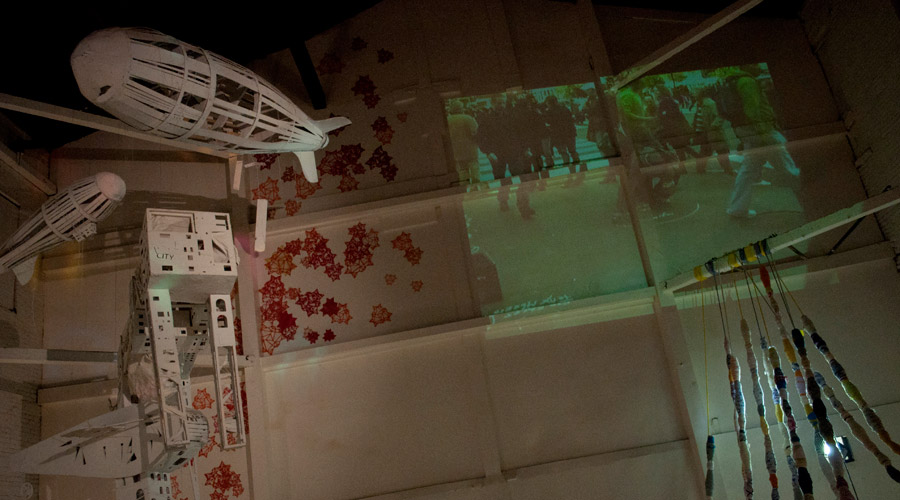


I just returned from a weekend in our nation’s capital where I caught the tail end of the National Cherry Blossom Festival at the Washington monument. Just down the Mall is the National American History Museum where I was able to finally view the Smithsonian pop-up exhibit, Paper Engineering: Fold, Pop, Pull and Turn. We learned about it on the blog here.
The show is a wonderful exploration of different pop-up techniques with fine examples of movable books that dated back hundreds of years. There are also two short videos on a loop that provide some excellent background about making pop-ups. Over a dozen cases are well laid out and very approachable to the many visitors that streamed in while I was there. The addition of two button activated page turners made the movable books come to life and show some of the excellent movement that can be achieved through paper engineering.
It was recently announced that there will be three upcoming lectures at the museum from some of the best pop-up artists in the world. On Saturday, April 16th at noon, David A. Carter will talk about his pop-up artistry. Then on Monday, April 18th, Andrew Baron will discuss his latest project creating a pop-up annual report. Finally, on Tuesday, May 10th, Bruce Foster pulls back the curtain on his latest Harry Potter book. Be sure to check the PDF flyer for popupbookseries for more details on this exciting lecture series.
Now I have to figure out a way to get back to Washington, D.C. this weekend.
~Kyle

Gearhead noun
1. A technology enthusiast, a person with a deep interest in the inner working of computers, automobiles, etc.
Etymology: From Middle English gere ‘equipment’ + Middle English head or Old English heafod.
~Gio


Here is the last of my recent batch of pop-up promotional pieces. I’d like to think that I saved the best for last, but I’ll let you be the judge. I offer you an Australian safety campaign for the Toyota Camry from 1993. Like the Mercedes advertisement from last week, this is another rubber band-activated mechanism with no provenance, so I will let this movable mailer speaks for itself.
(Imagined pitch meeting at the Toyota Motor Corporation, Australia, 1993)
Ad man: “Right-o, We need to liven up this dry information about the safety features of the new Toyota Camry. Any ideas, mates?
Copywriter: “How ‘bout we slap a chicken on top. Chickens make everything better.”
Ad man: “Fair dinkum, Fred Nerk, Let’s do it!”
~Kyle


Passe-Partout \pass-pahr-TOO\ noun
1. Something, for example a master key, that enables unrestricted access.
Etymology: From French, literally, passes everywhere, from passer (to pass) + partout (everywhere), from par (though) + tout (all).
~Gio

On April 6, 1896, the Olympic Games were reinstated in Athens 1,500 years after being banned by Roman Emperor Theodosius I as part of his efforts to suppress paganism in the Roman Empire. At the opening of the 1896 Athens Games, King Georgios I of Greece and a crowd of 60,000 spectators welcomed athletes from 13 nations to the international competition.
The first recorded Olympic Games were held at Olympia in the Greek city-state of Elis in 776 B.C., but it is generally accepted that the Olympics were at least 500 years old at that time. The ancient Olympics, held every four years, occurred during a religious festival honoring the Greek god Zeus.
The 1896 Olympics featured the first marathon competition, which followed the 25-mile route run by a Greek soldier who brought news of a victory over the Persians from Marathon to Athens in 490 B.C. Appropriately, a Greek, Spyridon Louis, won the first marathon at the 1896 Athens Games.

Swima is a genus of polychaete worm that lives in the deep ocean. These discarded gills somewhat resemble green "bombs" that remain illuminated for several seconds after they have been discarded. It is thought that this is a defensive mechanism rather than reproductive, as it is seen in both mature and juvenile individuals.
~Gio

Hubbub \huhb-uhb\ noun
1. Excited fuss or tumult from a crowd.
Etymology: It is probably related to ub ub ubub, a Scots Gaelic interjection expressing contempt, or to abu, an ancient Irish war cry. In any case, hubbub was first recorded (1555) in the phrase Irish hubbub and meant "the confused shouting of a crowd."
~Gio


Yu Jordy Fu has been exhibiting her artwork since the age of six. This London based artist has a background in Spatial Design and Architecture but it’s her 2008 series of ‘Cloud Lamps’ that caught my eye. Exhibiting great patience, she creates these intricate paper-cut landscapes inspired by her architectural design projects. The lamp shades are made from treated recycled paper and is “a simple and sustainable way to add intimacy and magic to domestic environments.” The shades series has since expanded to chandeliers, installations and other custom commissions and you can learn more about Yu Jordy Fu by checking out her blog.
~Kyle
Smalto \zmahl-taw\ noun
1. colored glass or similar vitreous material used in mosaic.
Etymology: From Italian smalto 'enamel, glaze’, related to smelt (to melt).
~Gio


Bowdoin College in Brunswick, Maine has put together a nice exhibit of pop-ups that will be on view in the Hawthorne-Longfellow Library until June 4, 2011. The curators selected more than 150 movable items from the 1,800 titles donated to the college by alumni Harold M. Goralnick for the show, “Pop-ups! They are not JUST for kids”.
Pop-ups! They're Not JUST for Kids from Bowdoin College on Vimeo.
Here’s what the folks at Bowdoin had to say about the show:
“Although we usually think of children’s books when we see “pop-ups,” these are definitely not all just for children—erotica, architecture, and political commentary join such predictable themes as fairy tales, rhymes and verse, the alphabet and counting, and animals, to name a few. Displayed works range from the late nineteenth century to the present and also include artists’ books that employ pop-up features in their design.”
Click here to view the press release for the exhibit.
~Kyle


Today’s selection is another mysterious pop-up advertisement. Back in the 1990’s Mercedes-Benz wanted to hand you “your passport to 21st century motoring”. Sadly, the faux passport that accompanied this pop-up mailer has gone missing, which would have shed some light on this campaign. Luckily, we can still enjoy the pop-up as is. This type of promotion would have been handed to potential clients or sent through the mail. Once taken out of the large envelope, the rubber band springs open a colorful car showroom, where a creepy looking magician/entertainer (who is a dead ringer for a chubby Dr. Doom) is unveiling the new Mercedes-Benz car model. If this is my passport to the future then it appears that I have nothing to declare.
~Kyle


One of the biggest events in the children’s book industry starts today. The Bologna Children’s Book Fair has just begun and lasts for the next four days. In it’s 48th edition, this fair brings together authors, illustrators, publishers, literary agents, packagers, printers, booksellers, librarians, and many more to learn about the latest trends and developments in children’s books. Pop-up packagers and paper engineers make their way to Italy to complete a marathon of meetings with publishers and manufacturers as they present the prototypes of new titles and ideas. With roughly 1300 exhibitors from 67 countries, the massive convention space is host to thousands of industry professionals (so no kiddies, here). Every year there is an honorary country promoted at the fair and this year’s guest will be Lithuania.
I have heard many great stories of past fairs in Bologna from pop-up artists like David Carter, Ron van der Meer, Robert Sabuda and Sam Ita, and hope that one day I will get a chance to wander the massive exhibition halls and get lost in a world of wonder and possibility. But I better plan ahead because even though it’s the first day of the Fair, hotels are already booking up for next year!
~Kyle


